

Abstract:
Selecting the right solar charge controller—either a PWM (Pulse Width Modulation) or an MPPT (Maximum Power Point Tracking) controller—plays a critical role in optimizing solar system performance. The decision impacts factors such as energy harvesting efficiency, battery lifespan, and total system cost.
Research published in *IEEE Transactions on Power Electronics* highlights that MPPT controllers can enhance energy extraction by 15–30% compared to simpler charge regulation methods, particularly under changing sunlight conditions.
Similarly, guidance from the National Renewable Energy Laboratory reinforces the importance of matching a charge controller with the specific voltage characteristics of the solar panels and battery setup to minimize power losses and avoid thermal stress.
Standards established by the IEC further classify the different control technologies based on power conversion mechanisms and safety compliance requirements.
This comprehensive industry guide for 2026 offers a detailed and practical analysis of PWM and MPPT controllers. It covers their operational principles, internal design, efficiency distinctions, cost-effectiveness, battery compatibility, performance under various conditions, optimal system sizing, and common errors in installation.
Introduction: Why Charge Controller Selection Is Critical in Solar Systems?
In off-grid or hybrid photovoltaic systems, the charge controller serves as a critical link between the solar panel array and the battery bank. Solar panels produce direct current (DC) electricity, but their voltage varies depending on factors such as sunlight intensity, temperature fluctuations, and load conditions. Without proper regulation, batteries risk being overcharged, undercharged, or even damaged due to excessive heat.
Modern solar charge controllers rely on two principal technologies:
- PWM (Pulse Width Modulation) controllers
- MPPT (Maximum Power Point Tracking) controllers
While both types are designed to regulate battery charging, their operational mechanisms and energy conversion approaches differ significantly. Choosing an unsuitable controller can lead to consequences such as reduced energy output, shortened battery lifespan, diminished overall system efficiency, and poor return on your solar investment.
A clear understanding of these technological differences is crucial for designing an optimized and reliable photovoltaic system.
What Is a PWM Controller?
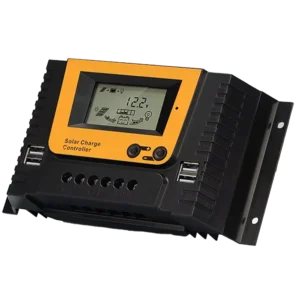
A PWM controller, or Pulse Width Modulation controller, is a conventional solar charge regulator designed to directly connect a solar panel to a battery. It manages the charging process by rapidly switching the connection between the panel and the battery on and off.
Functioning of PWM Technology:
PWM controllers work by:
- – Connecting the solar panel to the battery whenever charging is required.
- – Quickly disconnecting once the battery reaches a specific voltage threshold.
- – Adjusting the pulse width to sustain the desired battery voltage.
In essence, the controller forces the solar panel’s voltage to align with the battery’s voltage. Consequently, if a 24V panel (with a maximum power point voltage, or Vmp, of 36V) charges a 12V battery, the excess voltage is not utilized but instead wasted.
Key Electrical Characteristics:
- – No conversion of DC voltage levels.
- – Direct coupling between the panel and battery.
- Simpler electronic design.
- – Easier heat dissipation mechanism.
While PWM technology is dependable, its efficiency diminishes when the solar panel’s voltage significantly surpasses that of the battery.
What Is an MPPT Controller?
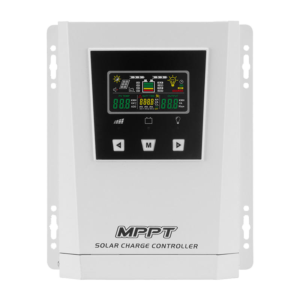
An MPPT controller, or Maximum Power Point Tracking controller, is a sophisticated device designed to optimize energy extraction from solar panels. By employing DC-DC conversion, it continuously modifies the electrical operating parameters to maximize power output.
Understanding the Maximum Power Point (MPP):
Solar panels produce power along a voltage-current curve with a distinct “maximum power point” (MPP). This optimal point varies with factors such as:
- – Sunlight intensity
- – Ambient temperature
- – Load conditions
The MPPT controller dynamically tracks this shifting point and converts the surplus voltage into additional current, ensuring maximum energy efficiency.
How MPPT Technology Functions:
In contrast to traditional Pulse Width Modulation (PWM) systems, MPPT controllers offer advanced features:
- – Continuous monitoring of the panel’s voltage and current
- – Calculation of the real-time maximum power point
- – Conversion of higher panel voltage to lower battery charging voltage
- – Efficient delivery of optimized energy to the battery system
For instance:
- – If a solar panel outputs 36V at 8A, the resulting power is 288W.
- – The MPPT controller adjusts this to match the battery’s charging voltage, say 14V, while maintaining overall power output.
- – This conversion boosts the current to approximately 20A (accounting for minimal conversion losses).
By performing these functions, the MPPT controller significantly enhances energy harvest, making it a fundamental component in modern solar energy systems.
Core Differences Between PWM and MPPT Controllers
| Feature | PWM Controller | MPPT Controller |
| Technology Type | Direct switching | DC-DC conversion |
| Voltage Matching | Forces the panel to battery voltage | Optimizes panel voltage |
| Efficiency | 70–80% typical | 95–99% typical |
| Cost | Low | Higher |
| Ideal Panel Match | Same voltage rating | Higher voltage panels |
| Cold Weather Performance | Limited gain | Significant gain |
| System Size Suitability | Small systems | Medium to large systems |
MPPT controllers clearly outperform PWM in most technical metrics, especially in variable climates.
Efficiency Comparison Under Real Conditions
Efficiency relies heavily on the system’s design.
- Temperature Effects:
In colder temperatures, solar panels experience an increase in voltage. While PWM controllers are unable to harness this extra voltage, MPPT controllers efficiently convert it into additional current. This advantage allows MPPT systems to generate 20–30% more energy in cold climates.
- Handling Partial Shading:
MPPT systems are more adept at adjusting to changes in irradiance caused by partial shading, ensuring a consistently higher energy yield.
- Long-Distance Cable Runs:
Transmitting electricity at higher voltages reduces energy loss due to resistance in cables. MPPT controllers accommodate higher array voltages, effectively minimizing resistive losses over extended cable lengths.
Battery Compatibility Considerations
Different battery chemistries require precise charging profiles.
| Battery Type | PWM Compatibility | MPPT Compatibility |
| Lead-Acid (Flooded) | Good | Excellent |
| AGM | Good | Excellent |
| Gel | Moderate | Excellent |
| Lithium (LiFePO4) | Limited advanced control | Strong compatibility |
MPPT controllers typically provide more advanced programmable charging stages, making them better for lithium systems.
Cost-Benefit Analysis
- Initial Investment
PWM controllers are more affordable and ideal for:
- – Small off-grid cabins
- – RV systems
- – Basic lighting setups
On the other hand, MPPT controllers come at a higher price because they feature:
- – Advanced circuitry
- – Power inductors
- – Microprocessor-based control
- Long-Term ROI
Over a period of 10 years or more:
- – MPPT systems maximize energy collection
- – Enhance the longevity of batteries
- – Minimize the need for additional solar panels
For medium to large-scale systems, the investment in MPPT controllers typically proves cost-effective over time.
Installation and System Design Differences
PWM Installation Requirements
Panel voltage must match battery voltage
Limited expansion flexibility
MPPT Installation Advantages
Allows higher voltage arrays
Supports flexible string design
Better scalability
Design flexibility is a major advantage in commercial systems.
When Should You Choose a PWM Controller?
A PWM controller may be sufficient when:
- Budget is highly constrained
- Solar array voltage matches battery
- System size is under 200W
- The climate is warm and stable
In these cases, efficiency gains from MPPT may not justify the cost.
When Should You Choose an MPPT Controller?
MPPT is strongly recommended for:
- Systems above 200W
- Lithium battery banks
- Cold climates
- Long cable installations
- High-voltage panels
- Professional installations
It ensures maximum performance and future scalability.
Common Mistakes in Controller Selection
Using PWM with high-voltage panels
Ignoring temperature impact
Undersizing controller amperage
Neglecting battery chemistry requirements
Choosing low-quality MPPT clones (not true MPPT topology)
Proper sizing and quality selection are essential.
Future Trends in Solar Charge Control (2026 and Beyond)
Innovation areas include:
AI-driven MPPT algorithms
Hybrid MPPT + inverter integration
Smart monitoring via IoT
Bluetooth and cloud diagnostics
High-frequency switching for compact design
MPPT technology continues to evolve, while PWM remains largely static.
FAQ: PWM vs MPPT Controllers
Q1: Is MPPT always better than PWM?
In most medium-to-large systems, yes. However, small systems may not justify the cost difference.
Q2: Can I replace a PWM controller with MPPT?
Yes, as long as the voltage and current ratings are compatible.
Q3: Does MPPT increase battery life?
Indirectly, yes, due to optimized charging profiles.
Q4: Is MPPT worth it for RV systems?
If panel voltage exceeds battery voltage significantly, yes.
Q5: How much more efficient is MPPT?
Typically, 15–30% higher energy harvest under real-world conditions.
Conclusion
The primary distinction between PWM and MPPT controllers lies in their energy conversion methods. PWM controllers manage voltage by directly switching the current, whereas MPPT controllers actively adjust and convert power to extract the maximum energy possible from solar panels.
For smaller-scale or budget-conscious setups, PWM controllers are a viable and cost-effective choice. However, for modern solar systems—particularly those incorporating lithium batteries, higher-voltage solar arrays, or operating in colder conditions—MPPT controllers deliver greater efficiency, adaptability, and long-term value.
As solar technology continues to advance in 2026 and beyond, MPPT controllers are steadily becoming the preferred standard for professional and commercial applications.