
Introduction
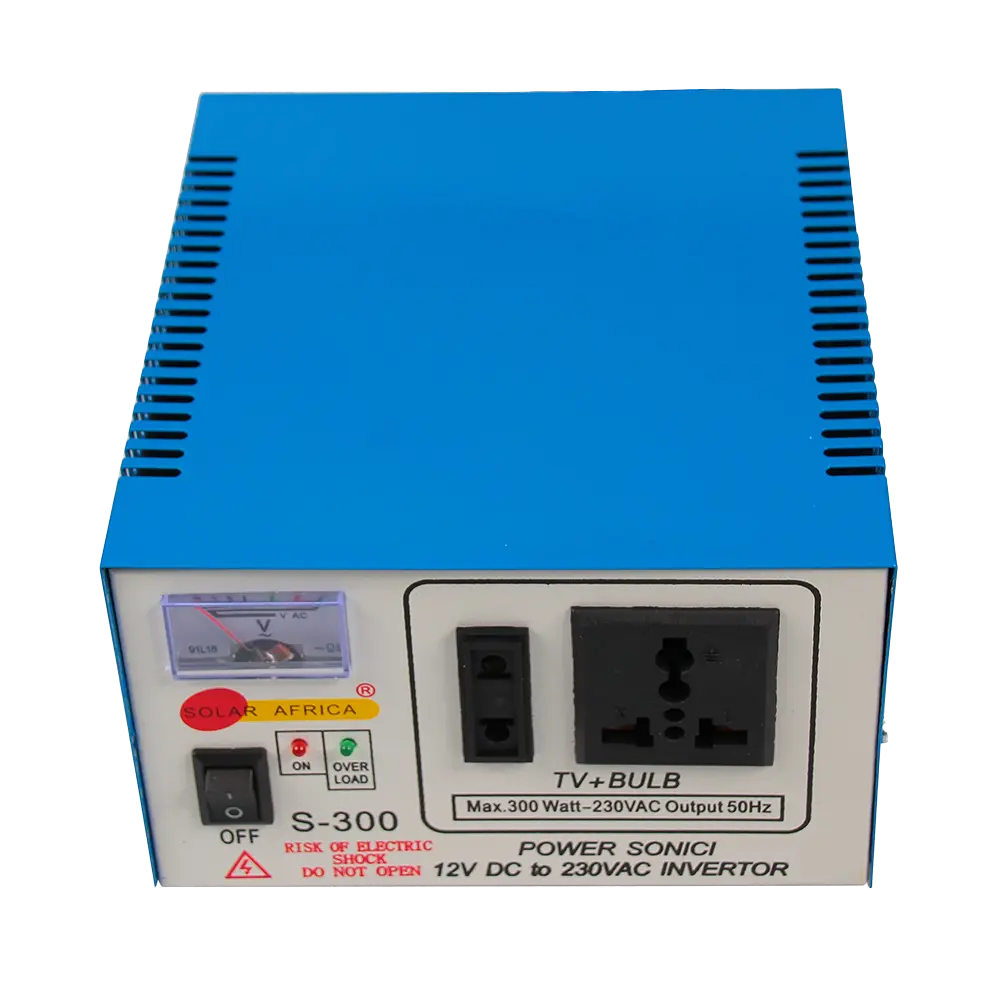
When off-grid solar is off your wallet, why not try a simple but very effective solution? The square wave inverter converts DC battery power to AC electricity. It is not suitable for sensitive electronics like laptops, but it is perfectly appropriate for lights, fans, phone chargers, power tools, and heating appliances.
This guide will help you understand how a square wave inverter works, how to select the best one for your system, and how it can save you money and simplify your solar setup.
What Is a Square Wave Inverter and How Does It Work?
A square wave inverter is the simplest type of DC-to-AC power conversion device. It takes direct current from a battery (typically 12V or 24V) and converts it into alternating current by rapidly switching the polarity of the DC input. The output is a basic square-shaped AC waveform, usually at 50 Hz or 60 Hz, matching the frequency of standard household electricity.
Inside the device, electronic switches—typically MOSFETs arranged in an H-bridge configuration—alternate the direction of current flow. No complex pulse-width modulation is involved. Just fixed high and low switching cycles. This minimalist design is exactly why a square wave inverter costs significantly less than sine wave alternatives and requires less technical knowledge to install and maintain.
The waveform looks like a blocky square when viewed on an oscilloscope, not the smooth, curving sine wave that utility companies deliver. That blocky shape is perfectly acceptable for many common appliances, but can cause problems for devices with transformers or electronic controllers.
Why a Square Wave Inverter Simplifies Off-Grid Solar
Off-grid solar systems already have enough complexity: panel orientation, battery bank sizing, charge controller selection, and wiring configurations. Adding an expensive, finicky inverter with dozens of settings only increases the chances of something going wrong.
A square wave inverter simplifies everything in four specific ways.
Fewer Components to Fail
Because the circuit design is straightforward, there are fewer parts that can break. No complex filtering stages, no high-speed microprocessors running cooling fans, no elaborate protection circuits that themselves can fail. The result is a device that often runs for years with nothing more than occasional dust removal.
No Configuration Headaches
You do not need to set output voltage curves, adjust frequency fine-tuning, or match waveform profiles to specific loads. Connect the DC input to your battery bank, connect your AC loads to the output, and turn it on. That is the entire setup process for most square wave inverter units.
Lower Cost Means Less Risk
When you invest hundreds of dollars in a pure sine wave inverter, you worry about it failing, getting stolen, or being damaged by a surge. A square wave inverter typically costs one-third to one-half as much. That lower price point means you can keep a spare unit on hand without breaking your budget. If one fails, you swap in the backup in minutes and keep your lights on.
Works with Simple, Rugged Loads
Off-grid life often relies on basic appliances: incandescent or LED lights, ceiling fans, water pumps (non-variable-speed types), soldering irons, heat guns, coffee makers, and electric kettles. All of these run perfectly well on a square wave inverter because they are resistive or simple inductive loads that do not care about waveform purity.
Where a Square Wave Inverter Excels: Real-World Applications
A square wave inverter is not for everyone, but for certain users and scenarios, it is the best possible choice.
Cabin and Tiny Home Power
Seasonal cabins and tiny homes often run on modest solar setups with 200 to 500 watts of panels and a few hundred amp-hours of battery storage. The appliances are basic: a few lights, a radio, a fan, and maybe a small refrigerator with a standard compressor (not an inverter type). A 300W or 500W square wave inverter handles these loads easily and costs under $50.
Workshop or Garage Power
Many workshops already use universal motors in drills, grinders, saws, and sanders. Universal motors run just fine on square wave power. In fact, they often run slightly faster because the higher peak voltage of a square wave delivers more torque. For tool charging stations, a square wave inverter can power multiple battery chargers simultaneously without issue.
Emergency Backup for Essential Circuits
When the grid goes down, you do not need to run your whole house. You just need lights, a fan, and a way to charge phones and radios. A small square wave inverter connected to a single 12V deep-cycle battery provides exactly that level of backup for under $100. Keep it in a closet, and when the power fails, you are up and running in seconds.
Off-Grid Workshops in Remote Areas
Construction sites, agricultural operations, and remote mining camps often need AC power for tools, pumps, and heating devices. A square wave inverter is rugged, portable, and easily replaceable. Workers do not need special training to operate it. And if a unit gets damaged by dust or moisture, the replacement cost is low enough to keep several on hand.
Square Wave vs. Modified Sine Wave vs. Pure Sine Wave: What Is the Difference?
Many people confuse a square wave with a modified sine wave. They are different, and understanding the difference helps you choose the right inverter for your off-grid solar setup.
| Inverter Type | Waveform Quality | Relative Cost | Typical Efficiency | Compatible Loads |
|---|---|---|---|---|
| Square Wave | Lowest (blocky square) | $ (least expensive) | 85–90% | Resistive loads (lights, heaters, universal motors) |
| Modified Sine Wave | Medium (stepped approximation) | $$ | 85–92% | Most power tools, some electronics, and older TVs |
| Pure Sine Wave | Highest (smooth, grid-like) | $$$$ | 90–95% | All loads, including medical devices, variable-speed motors, and modern appliances |
A pure sine wave inverter is the gold standard. It produces power as clean as or cleaner than the utility grid. But that quality comes at a price, often three to five times higher than a square wave inverter of the same wattage.
A modified sine wave inverter is a middle ground. It produces a waveform that is shaped like a staircase, closer to a sine wave than a square wave but still imperfect. Most modern inverters sold for entry-level off-grid systems are actually modified sine wave, though many sellers still call them square wave incorrectly.
True square wave inverter units are now relatively rare, found mostly in very low-cost, low-wattage (100W–500W) products. They are ideal for the simplest applications where cost is the primary constraint and loads are purely resistive.
Wattage Sizing: How to Choose the Right Square Wave Inverter
Sizing a square wave inverter for your off-grid solar setup requires understanding two numbers: continuous wattage and surge wattage.
Continuous wattage is the power the inverter can deliver indefinitely. If you plan to run a 100W light bulb and a 50W fan simultaneously, you need at least 150W continuous.
Surge wattage is the extra power needed to start motors or devices with capacitors. A water pump might draw 200W while running, but needs 600W to start. Most square wave inverter units can handle surges of 2 to 3 times their continuous rating for a few seconds.
Here is a quick sizing guide for common off-grid loads on a square wave inverter:
-
100W unit: Phone chargers (2–3), LED lights (5–6), radio
-
150W unit: Laptop charger (non-sensitive models), small fan, light string
-
200W unit: Drill or small power tool, soldering iron, 32-inch TV (older type)
-
300W unit: Water pump (small), coffee maker, electric kettle (small)
-
500W unit: Circular saw, grinder, multiple tool chargers
Always add a 20% safety margin. If your expected maximum continuous load is 250W, buy a square wave inverter rated for at least 300W.
Installation and Wiring Tips for Maximum Reliability
A square wave inverter is simple to install, but a few best practices will keep it running safely for years.
Use the Right Cable Gauge
DC is much higher than AC for the same power. A 300W inverter drawing full power from a 12V battery pulls about 25 amps (300W ÷ 12V). That requires at least 10 AWG copper cable for short runs under 5 feet. For a 500W unit, use 6 AWG. Undersized cables cause voltage drop, overheating, and premature inverter shutdown.
Keep Cables Short
Every foot of DC cable adds resistance and voltage drop. Mount your square wave inverter as close to the battery bank as practical. If you need to extend, use a thicker cable to compensate.
Add a Fuse or Circuit Breaker
Place a fuse or DC-rated breaker on the positive cable within 7 inches of the battery terminal. The fuse rating should be 1.25 times the inverter’s maximum continuous input current. For a 300W inverter at 12V (25A continuous), use a 30A or 35A fuse.
Ventilate the Unit
Square wave inverters generate heat during operation, especially at high loads. Mount the unit in a location with free air circulation. Do not enclose it in a sealed box or stuff it into a crowded electrical panel. If the inverter feels too hot to touch, improve airflow.
Ground Properly
Connect the inverter’s ground terminal to your system’s common ground bus bar or to a ground rod. This protects against shock hazards and helps the inverter’s internal protection circuits function correctly.
Advantages and Limitations: An Honest Look
Every technology has trade-offs. Here is a clear breakdown of what a square wave inverter does well and where it falls short.
Advantages:
-
Lowest upfront cost of any inverter type
-
Simple design with few failure points
-
Easy to repair or replace
-
Low standby power consumption (often under 1 watt)
-
Works well with resistive loads like incandescent lights and heaters
-
Compatible with universal motors found in many power tools
Limitations:
-
Cannot run sensitive electronics like modern computers, TVs, or medical devices
-
May cause an audible hum or buzzing in audio equipment
-
Reduces the efficiency of some inductive loads (motors run hotter)
-
Not suitable for devices with electronic speed controls or timers
-
Can damage certain battery chargers that rely on sine wave zero-crossing detection
If your off-grid solar setup only needs to power lights, fans, basic tools, and heating devices, these limitations are irrelevant. You save money and gain simplicity.
Comparing Square Wave Inverters to Other Off-Grid Power Options
A square wave inverter is not the only way to get AC power from batteries. Here is how it compares to other common solutions.
Square wave inverter vs. generator: A generator provides high power but requires fuel, oil changes, spark plugs, and noise management. A square wave inverter is silent, maintenance-free (aside from occasional dusting), and runs as long as your battery has charge. For low-power applications, the inverter wins on convenience and operating cost.
Square wave inverter vs. pure sine wave inverter: The pure sine wave unit runs everything, but costs much more. If your loads are simple, the extra expense buys you nothing except unused capability. Choose a square wave when budget matters more than versatility.
Square wave inverter vs. DC appliances: You could avoid inverters entirely by buying DC-powered lights, fans, and phone chargers. But DC appliances are less common, often more expensive, and limit your choices. A square wave inverter lets you use standard AC appliances from any hardware store, often at a fraction of the price.
Battery Bank Sizing for Square Wave Inverter Systems
Your inverter is only useful if your battery bank can support it. Calculate your daily watt-hour consumption, then size the battery bank accordingly.
For example, suppose you run a 100W light for 4 hours (400 watt-hours) and a 50W fan for 8 hours (400 watt-hours) each day. Total daily consumption is 800 watt-hours.
With a 12V battery bank, 800 watt-hours divided by 12V equals about 67 amp-hours of usable energy. But lead-acid batteries should not be discharged below 50% depth of discharge for good cycle life. So you need at least 134 amp-hours of rated battery capacity.
A single 12V, 150Ah deep-cycle battery would run this load comfortably. A square wave inverter sized at 300W would handle the peak loads with room to spare.
If you use lithium batteries, you can discharge them to 80–90%. A 12V, 100Ah lithium battery would provide about 960 watt-hours of usable energy (12V × 100Ah × 0.8), more than enough for our 800-watt-hour example.
Common Myths About Square Wave Inverters Debunked
Myth 1: Square wave inverters damage all appliances.
False. They damage nothing. Some appliances may not operate correctly or may run less efficiently, but damage is rare. Resistive loads and universal motors work fine for years on square wave power.
Myth 2: Square wave inverters are dangerous.
No. They are as safe as any other inverter when properly installed with correct fusing and grounding. The waveform shape does not affect electrical safety.
Myth 3: Modern pure sine wave inverters are always worth the extra money.
Not for simple systems. If you never plug in a laptop, variable-speed fan, or modern refrigerator, the extra cost of a pure sine wave inverter is wasted. A square wave inverter does the same job for less money.
Myth 4: Square wave inverters are obsolete.
In high-end solar installations, yes. In budget, portable, or emergency systems, no. They continue to sell in large volumes worldwide because they solve a real problem at a very low price.
Maintenance and Troubleshooting
A square wave inverter requires very little maintenance. Here is what to check periodically.
-
Inspect DC connections for corrosion or looseness once every six months. Tighten any loose terminals.
-
Clean dust from ventilation slots using compressed air or a soft brush. Clogged vents cause overheating.
-
Test the unit with a known good load (like an incandescent lamp) every few months if it sits idle.
-
Listen for unusual buzzing or clicking, which may indicate failing capacitors or loose connections inside.
If your square wave inverter stops working, check the fuse first. Then measure battery voltage at the inverter terminals. Low battery voltage or high resistance from a corroded connection is the cause of most failures. If both are good, the inverter likely has an internal failure; given the low cost, replacement is usually more practical than repair.
FAQ
1. Can a square wave inverter run a refrigerator?
It depends on the refrigerator. Older models with standard compressors often run, but less efficiently. Newer inverter-type refrigerators with variable-speed compressors will not run correctly. Check your refrigerator’s specifications before attempting.
2. Will a square wave inverter damage my phone charger?
Most modern phone chargers are switching power supplies that accept a wide range of input waveforms. They typically work fine on square wave power. However, very cheap chargers may run hotter. Stick with name-brand chargers for safety.
3. How efficient is a typical square wave inverter?
Efficiency ranges from 85% to 90% at full load. At very low loads (under 10% of rated power), efficiency drops significantly. For best efficiency, size your inverter so your typical load is at least 30% of its rated capacity.
4. Can I connect two square wave inverters to get 220V?
This is not recommended unless the inverters are specifically designed for series or parallel operation. Most cheap square wave inverters lack synchronization circuits. Connecting them improperly will damage both units.
5. How long does a square wave inverter last?
With moderate use and good ventilation, expect 5 to 10 years of service. Electrolytic capacitors dry out over time, but replacement is inexpensive. Many users find their square wave inverters outlast more expensive pure sine wave units that fail from heat or complex circuitry.
Conclusion: Simple, Affordable, and Still Useful
A square wave inverter will never win a technology beauty contest. Its output is rough, its applications are limited, and its waveform would make an electrical engineer wince. But for the off-grid solar user who just wants to turn on a light, charge a phone, or run a drill, it is perfectly adequate and remarkably inexpensive.
The beauty of a square wave inverter lies in its simplicity. No settings to misconfigure. No expensive components to fail. No manuals to read. Just DC in, AC out, and reliable service for years.
If your off-grid solar setup powers only basic, rugged loads, do not let anyone convince you that you need a pure sine wave inverter. Save your money, buy a square wave inverter, and put the difference toward more solar panels or a larger battery bank. That investment will serve you far better than the waveform purity you never needed.
Ready to simplify your off-grid solar system with an affordable square wave inverter?
Browse our selection of DC-to-AC converters designed specifically for remote power applications. Whether you need 100W for emergency backup or 300W for a workshop setup, we have a reliable, budget-friendly solution. Contact our team for help sizing the right unit for your exact loads—no upsell, just honest advice.