
Introduction: The Hidden Drain on Your Solar Investment
You’ve invested thousands in solar panels, batteries, and installation. But are you really getting all the power you paid for? Most standard charge controllers waste 20–30% of the energy your panels generate—simply because they can’t adapt to changing sunlight and battery conditions. That lost energy translates to longer charging times, lower battery life, and a slower return on your investment.
Let’s talk about the MPPT solar charge controller. This isn’t just your average regulator—it acts more like an energy optimizer, pulling as much power as possible from your solar panels. Whether you’re running a remote cabin, an RV, a boat, or a home hybrid system, an MPPT controller can often increase your daily energy harvest by 15 to 30 percent compared to the more traditional PWM controllers. In this detailed guide, we’ll explore how MPPT technology actually works, where it’s most effective, and what you should consider when picking the right one for your system. By the time you’re done, you’ll understand why switching to an MPPT controller can be a smart upgrade for nearly any solar setup.
What Is an MPPT Solar Charge Controller? A Clear Technical Breakdown
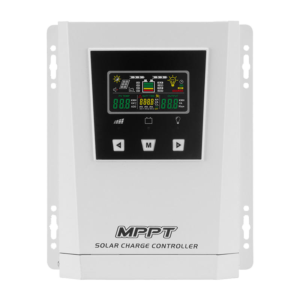
An MPPT solar charge controller (Maximum Power Point Tracking) is an intelligent electronic device that sits between your solar panels and battery bank. Its job is twofold: prevent overcharging (protecting battery health) and—more importantly—extract the maximum possible power from your solar panels at any given moment. Every MPPT solar charge controller uses advanced algorithms to continuously track the panel’s maximum power point.
The Core Technology: Maximum Power Point Tracking Explained
Solar panels have a complex relationship between voltage and current. At a specific combination of voltage (V) and current (I), the panel delivers its maximum power (P = V × I). This sweet spot shifts constantly with sunlight intensity, temperature, shading, and panel degradation. A standard PWM controller simply connects the panel to the battery, pulling voltage down to match the battery’s level—wasting all the excess voltage potential.
An MPPT solar charge controller functions like a highly efficient DC-DC converter. It continuously monitors the solar panel’s output, figures out the true maximum power point (MPP), and then adjusts the voltage to increase the charging current. Take a 36V solar panel charging a 12V battery as an example: a PWM controller limits the panel’s voltage to roughly 12V, which means you lose more than 60% of the panel’s potential power. In contrast, an MPPT controller tracks the MPP, usually between 30 and 35 volts, and converts that down to the 14.4V needed to charge the battery, while raising the current accordingly. Aside from a small conversion loss—typically around 2 to 5%—the power coming in closely matches what’s going out. This means you’re utilizing almost all the rated power of the solar panel. That efficiency is exactly why MPPT controllers are essential for any serious off-grid solar setup.
Key Components That Make MPPT Superior
-
High-frequency switching MOSFETs – Enable efficient voltage conversion with minimal heat, a hallmark of any quality MPPT solar charge controller.
-
Microcontroller/DSP – Runs the tracking algorithm (P&O, Incremental Conductance, or Fuzzy Logic) to find the true MPP in milliseconds.
-
Temperature sensor – Compensates charging voltage based on battery temperature (critical for lead-acid longevity). Many MPPT solar charge controller models include this as standard.
-
LCD/App interface – Displays real-time data: panel voltage/current, battery state of charge, harvested energy (kWh), and error logs. A modern MPPT solar charge controller makes monitoring effortless.
Why Upgrade to an MPPT Charge Controller? 5 Data-Backed Benefits
Still wondering if the extra cost (typically 2–3x PWM) is worth it? Here are the quantifiable advantages of installing an MPPT solar charge controller.
1. Up to 30% More Energy Harvest – Especially in Low Light
Independent tests by NREL and Sandia Labs show that an MPPT solar charge controller outperforms PWM by 15–30% in winter, cloudy conditions, or early morning/late afternoon. Why? MPPT tracks the MPP even when the voltage drops due to low irradiance. A PWM controller would simply disconnect when the panel voltage falls below battery voltage. For an off-grid home relying on solar year-round, that extra 30% can mean the difference between running a generator or not. Choosing an MPPT solar charge controller is the most effective upgrade you can make.
2. Supports Higher Voltage Solar Arrays
One major benefit of an MPPT solar charge controller is its ability to handle panel voltages well above battery voltage. You can wire panels in series to reach 100V, 150V, or even 600V (for large systems) while charging a 12V, 24V, or 48V battery bank. Higher voltage arrays reduce current, which lowers resistive losses (I²R losses) in long cable runs. For a ground-mounted array 100 feet from your battery shed, switching from 12V to 120V array voltage slashes cable loss from 10% to less than 0.5%. A good MPPT solar charge controller makes this possible.
3. Extends Battery Life by Up to 50%
All MPPT controllers include multi-stage charging (bulk, absorption, float, and equalization) with temperature compensation. Unlike basic PWM controllers that might overcharge or undercharge, an MPPT solar charge controller precisely tailors the charging profile to your battery type (Flooded, AGM, Gel, or Lithium). Proper charging reduces sulfation and corrosion, typically extending lead-acid battery lifespan from 3–5 years to 5–7 years. For lithium batteries, an MPPT solar charge controller’s precise constant current/constant voltage (CC/CV) algorithm prevents cell stress, maximizing cycle life.
4. Cold-Weather Bonus – Higher Power Than Rated
Solar panels tend to work more efficiently in colder weather because their voltage increases as the temperature drops. However, a PWM controller limits this extra voltage, effectively wasting it. In contrast, an MPPT solar charge controller can convert that additional voltage into usable current. For instance, on a sunny day around -10°C, a 100W panel might produce between 110 and 120 watts, and an MPPT controller can capture all that power. This makes MPPT controllers particularly valuable for off-grid setups in colder northern regions, where they consistently perform well.
5. Detailed Monitoring & Remote Control
Modern MPPT controllers come with Bluetooth, Wi-Fi, or RS485 ports. You can check real-time data on your phone, adjust settings, and even update firmware. Some integrate with home energy management systems (e.g., Victron’s Venus OS, EPEver’s Solar Station Monitor). This data helps you diagnose panel issues, optimize tilt angles, and track your ROI. When you buy an MPPT solar charge controller, look for these smart features.
Real-World Applications – Where MPPT Shines Brightest
Off-Grid Cabins & Tiny Homes
A typical off-grid system might have 800W of panels, a 400Ah battery bank, and a daily consumption of 2kWh. Using a PWM controller, you’d get only ~1.4kWh on a winter day—forcing generator use. With an MPPT solar charge controller, you capture ~1.8kWh, keeping batteries topped up. For a family living off-grid, that extra 0.4kWh per day means lights, fridge, and phone charging without backup. Installing an MPPT solar charge controller transforms your energy independence.
RVs and Van Conversions
Space is tight on an RV roof—you can’t just add more panels. Maximizing the limited area is critical. An MPPT solar charge controller allows you to wire two 200W panels in series (48V) to charge a 12V lithium battery. Higher voltage reduces cable thickness (saves weight and cost) and performs far better when driving through patchy tree shade. Many van-lifers report a 25% increase in daily harvest after switching from PWM to an MPPT solar charge controller.
Marine (Sailboats & Motor Yachts)
On a boat, shading from masts and rigging causes frequent partial shading. An MPPT solar charge controller with global MPPT tracking (not just local peak) can find the true maximum power point even under complex shading patterns. Plus, waterproof or conformal-coated models resist salt corrosion. Cruisers often pair an MPPT solar charge controller with high-voltage panels (e.g., 2x 100W in series for 24V nominal) to keep wiring simple and efficient.
Residential Hybrid Solar Systems
Even if you’re grid-tied, adding an MPPT solar charge controller for battery backup (e.g., with a hybrid inverter) ensures your panels charge batteries at the highest possible rate. When the grid fails, you want every watt from your panels to extend backup runtime. MPPT is the standard in all premium hybrid inverters (Tesla Powerwall+, Sonnen, etc.) for a reason. An MPPT solar charge controller is non-negotiable for serious backup systems.
MPPT vs. PWM – Side-by-Side Comparison
To help you see why an MPPT solar charge controller is superior, here’s a detailed comparison table.
| Feature | MPPT Solar Charge Controller | PWM Solar Charge Controller |
|---|---|---|
| Energy harvest | 15–30% more (especially in low light/cold) | Baseline (100% of what’s available at battery voltage) |
| Panel voltage | Can be much higher than battery voltage (up to 600V for some models) | Must match battery voltage (e.g., 12V panel for 12V battery) |
| Array configuration | Series or series-parallel; high voltage reduces cable loss | Parallel only (voltage = battery voltage) |
| Efficiency | 93–99% (conversion loss 1–7%) | 98–99% (but only when panel & battery voltages match; otherwise, much lower effective efficiency) |
| Battery charging stages | Advanced: bulk, absorption, float, equalization, temperature compensation | Basic: often just bulk and float (no temp comp on cheap models) |
| Monitoring | Bluetooth, Wi-Fi, LCD, data logging | Usually just LEDs or a simple voltmeter |
| Cost | $80–$800+ (depending on amps/voltage) | $15–$150 |
| Best for | Systems >200W, cold climates, any off-grid/RV/marine, lithium batteries | Small systems (<200W), simple garden/pump lights, budget builds |
Conclusion of the comparison: If your solar array is larger than 200W, if you ever face cloudy weather, if you want to maximize battery life, or if you plan to expand later, choose an MPPT solar charge controller. The extra upfront cost pays for itself in harvested energy within 6–18 months.
How to Choose the Right MPPT Solar Charge Controller – A Sizing Guide
Selecting the correct MPPT solar charge controller prevents fires and ensures peak performance. Follow these steps.
Step 1 – Determine Battery Bank Voltage
Most small RVs use 12V; larger off-grid homes use 24V or 48V. Your MPPT solar charge controller must match that voltage (many MPPT controllers auto-detect 12/24/36/48V). For a 48V system, ensure the controller’s max PV voltage is high enough to handle series strings.
Step 2 – Calculate Required Charging Current (Amps)
Take total solar array wattage (e.g., 800W). Divide by battery bank voltage (e.g., 24V). 800W / 24V = 33.3A. Then add 25% safety margin for over-paneling and cold-weather overproduction. 33.3A × 1.25 = 41.6A. Choose an MPPT solar charge controller rated for 40A or 50A. Many manufacturers offer 40A, 60A, 80A models.
Important: Some MPPT controllers allow “over-paneling” (connecting more panel watts than rated output amps) because they limit current. For example, a 40A MPPT solar charge controller can handle up to 40A × 24V = 960W nominal, but you might install 1200W of panels—on a perfect day, it simply clips output at 40A. This is safe (if the manufacturer allows) and improves low-light performance.
Step 3 – Check Max PV Input Voltage (Voc)
This is critical. Look at the open-circuit voltage (Voc) of your panels (on the label). For panels in series, add the Voc of all panels. Multiply by a cold temperature correction factor (1.2 for -10°C, 1.25 for -25°C). That number must be less than the controller’s maximum PV input voltage. For example, two 24V panels, each with Voc=37V → series Voc=74V. At -20°C, voltage rises ~15% → 85V. Choose an MPPT solar charge controller rated for ≥100V input. Common ratings: 100V, 150V, 250V, 600V.
Step 4 – Match Battery Type Features
If you have lithium batteries (LiFePO4), ensure the MPPT solar charge controller has a user-adjustable or dedicated lithium profile with correct absorption voltage (14.2–14.6V for 12V) and no equalization. For lead-acid, temperature compensation is a must if the battery is outdoors.
Step 5 – Consider Extra Features
-
Remote display – Useful if the controller is in a cramped compartment.
-
Data logging – Tracks monthly kWh production.
-
Load output – Some controllers have a low-voltage disconnect (LVD) for DC lights/appliances.
-
Fan or passive cooling – High-current models (≥40A) often have fans; ensure good airflow.
Installation and Wiring Tips for Maximum Performance
Even the best MPPT solar charge controller will underperform if installed incorrectly. Follow these guidelines.
-
Keep cables short – Between controller and battery: less than 3 feet (1 meter) if possible. Longer cables need a thicker gauge.
-
Use proper fuses/breakers – Install a DC breaker between panels and controller, and between controller and battery. This allows safe disconnection.
-
Connect battery first – Always connect the battery to the MPPT solar charge controller before solar panels. This allows the controller to detect system voltage. Disconnect in reverse order: panels first, then controller.
-
Never overshoot input voltage – Exceeding max Voc will instantly destroy the controller. Respect the margin.
-
Mount in a cool, dry place – MPPT efficiency drops 0.5% per °C above 25°C. Ventilate the compartment.
-
Use a battery temperature sensor (included with many models) – For lead-acid, every 10°C change shifts the ideal voltage by 0.3V per 12V bank. Without compensation, you’ll lose battery life.
FAQ
Q1: Does an MPPT solar charge controller work with any solar panel?
Yes, as long as the panel’s open-circuit voltage (Voc) does not exceed the controller’s maximum input voltage rating, and the panel type (mono, poly, thin-film) is standard. An MPPT solar charge controller works excellently with all common panel types. For thin-film (amorphous) panels, some older MPPT controllers may struggle, but modern units handle them fine.
Q2: How much efficiency gain can I expect switching from PWM to an MPPT solar charge controller?
In optimal conditions (hot, full sun, perfectly matched panel/battery voltage), the gain is only 5–10%. But in real-world conditions—clouds, morning/afternoon, winter cold, or slightly mismatched panel voltages—the gain typically ranges from 15% to 30%. For a 500W system, that’s an extra 75–150Wh per day, which over a year adds up to 27–55kWh—enough to run a small fridge for months. That’s the power of an MPPT solar charge controller.
Q3: Can I use an MPPT solar charge controller with a lithium iron phosphate (LiFePO4) battery?
Absolutely. In fact, an MPPT solar charge controller is the preferred choice for lithium because lithium batteries accept high charge currents up to 1C (full charge in one hour). MPPT’s ability to deliver maximum current without overvoltage protects the battery’s BMS. Just ensure the MPPT solar charge controller has a lithium-specific charging profile (constant current until absorption voltage, then constant voltage until current drops). Most modern MPPT controllers (Victron, EPEver, Renogy, Outback) have a “Lithium” preset.
Q4: What size MPPT solar charge controller do I need for a 400W solar panel system?
If you have a 400W array and a 12V battery bank: 400W / 12V = 33.3A. Add 25% margin → 41.6A. So a 40A or 50A MPPT solar charge controller is appropriate. For a 24V battery: 400W / 24V = 16.7A × 1.25 = 20.8A → choose a 20A or 30A MPPT solar charge controller. Always check the max PV voltage if panels are in series. Use our sizing guide to pick the right MPPT solar charge controller.
Q5: Will an MPPT solar charge controller stop charging when my battery is full?
Yes. All quality MPPT controllers, including every MPPT solar charge controller we recommend, have a multi-stage charging algorithm. Once the battery reaches the absorption voltage (e.g., 14.4V for 12V lead-acid), the controller holds that voltage for a set time, then drops to a lower float voltage (13.6V) to maintain full charge without overcharging. For lithium, it stops charging completely when the battery’s BMS signals 100% SOC or when the current drops to a tail threshold.
Conclusion – Unlock the Full Potential of Your Solar Investment
Your solar panels are capable of so much more than a basic controller allows. An MPPT solar charge controller isn’t an expensive add-on—it’s an essential component that pays for itself by capturing energy that would otherwise be wasted. Whether you’re living off-grid, traveling in an RV, cruising on a sailboat, or building a home backup system, an MPPT solar charge controller delivers:
-
Up to 30% more daily energy
-
Faster battery charging (especially in low light)
-
Longer battery lifespan through proper charging algorithms
-
Flexibility to design high-voltage, low-loss solar arrays
-
Real-time data to optimize your system
Don’t leave money on the table. If your current charge controller is a basic PWM, now is the time to upgrade to a high-quality MPPT solar charge controller. Browse our selection of top-rated MPPT solar charge controllers—from compact 10A units for small cabins to heavy-duty 80A models for whole-home systems. Every purchase includes free lifetime tech support and a 5-year warranty.