
Einführung
For years, P-type monocrystalline panels dominated the solar market due to their lower cost and mature manufacturing processes. Today, however, N-type technology is rapidly becoming the industry standard thanks to its higher efficiency, lower degradation, and stronger long-term energy performance.
So, are N-type monocrystalline solar panels more efficient than P-type panels? In most cases, yes. They typically deliver higher conversion efficiency, better temperature performance, and greater lifetime energy yield. In this article, we’ll compare the two technologies across efficiency, degradation, bifacial gain, and ROI to help you determine the best option for commercial and utility-scale solar projects.
What Makes N-Type Monocrystalline Solar Panels Different from P-Type?
The fundamental distinction between N-type monocrystalline solar panels and P-type counterparts lies in the doping process used to create the semiconductor junction. This atomic-level difference cascades into every performance metric that matters—and it’s why N-type monocrystalline solar panels have become the preferred choice for serious solar developers worldwide.
The Doping Difference: Phosphorus versus Boron
Every silicon solar cell begins with a base wafer that is “doped” with impurity atoms to create either a surplus of free electrons (negative, or N-type) or a deficit (positive, or P-type). N-type monocrystalline solar panels utilize phosphorus as the dopant. Phosphorus possesses five valence electrons, one more than silicon’s four, so it readily contributes an extra free electron to the crystal lattice. This makes the material inherently electron-rich, with higher carrier mobility and significantly reduced recombination centers.
P-type cells, on the other hand, rely on boron doping. Boron has only three valence electrons, creating “holes” (positive charge carriers). While this approach is cheaper and historically easier to scale, it introduces a fatal flaw: boron readily pairs with residual oxygen atoms in the silicon lattice to form boron‑oxygen complexes. These complexes act as powerful recombination centers, trapping electron‑hole pairs and sapping efficiency. N-type monocrystalline solar panels entirely avoid this issue because phosphorus does not form such detrimental complexes with oxygen.
Minority Carrier Lifetime: A Ten-Thousand-Fold Advantage
The minority carrier lifetime—the average time a charge carrier exists before recombining—is a direct indicator of cell quality. In N-type monocrystalline solar panels, the lifetime can reach 10 to 100 milliseconds, while P-type wafers typically achieve only 0.1 to 1 microsecond. This difference of up to 10,000× translates directly into lower recombination losses. Under standard test conditions, N-type cells exhibit 20‑30% lower recombination loss than P-type cells. For the same 1 m² of silicon, an N-type cell can collect approximately 0.5 amperes more current—a gain that accumulates over every daylight hour.
How TOPCon Technology Enables These Gains
The superior lifetime of N-type monocrystalline solar panels enables advanced passivation structures like TOPCon (Tunnel Oxide Passivated Contact). In a TOPCon cell, an ultra‑thin silicon oxide layer, just 1‑2 nanometers thick, is grown on the rear surface. This oxide layer acts like a selective sieve—electrons can tunnel through via quantum mechanical tunneling, while holes are effectively blocked. A heavily doped polysilicon layer (150‑200 nm) is then deposited atop the oxide, creating an excellent contact that suppresses recombination. This sophisticated architecture is why modern N-type monocrystalline solar panels can achieve laboratory efficiencies exceeding 27%, a threshold P-type cells struggle to approach.
Efficiency Comparison: N-Type Monocrystalline Solar Panels vs. P-Type
To quantify the advantage, the following table summarizes key performance metrics based on publicly available data and independent test reports. For procurement teams comparing N-type monocrystalline solar panels against P-type PERC alternatives, these numbers provide the basis for financial modeling and technology selection.
| Metric | N-Type Monocrystalline Solar Panels | P-Type Monocrystalline (PERC) |
|---|---|---|
| Cell efficiency (lab record) | Up to 27.1% (TOPCon), 27.9% (TBC) | Up to 26.6% (PERC) |
| Module efficiency (commercial) | 23% – 25.6% (TOPCon/HJT) | 22% – 24% (PERC) |
| First‑year light‑induced degradation (LID) | < 0.5% (typ. 0.26%) | 1.5 – 3.0% (up to 3.09%) |
| Light & elevated temperature induced degradation | ~0.1% | ~1.2% |
| Annual degradation rate | 0.25 – 0.40% | 0.50 – 0.70% |
| Temperature coefficient (Pmax) | -0.26 to -0.31%/°C | -0.35 to -0.45%/°C |
| Bifaciality factor | 75 – 88% (certified up to 88.3%) | 65 – 75% |
| 25‑year power retention | 88 – 90% | 80 – 84% |
These figures reveal a clear trend: N-type monocrystalline solar panels outperform P-type in every meaningful metric. At the module level, the efficiency gap is typically 1‑3 percentage points absolute. But when degradation and temperature coefficients are factored in, the lifetime energy yield advantage grows to 5‑10% or more, depending on site conditions. For commercial solar procurement decisions, this translates directly to higher revenue per installed megawatt.
Why N-Type Monocrystalline Solar Panels Deliver More Energy Over Time
Rated efficiency under Standard Test Conditions is one thing; real‑world energy production over 25 years is another. N-type monocrystalline solar panels excel in several dimensions that translate directly into higher kilowatt‑hour output per installed watt. For EPC firms and asset owners, these advantages mean better project economics and more predictable returns.
Light‑Induced Degradation and LeTID: The Silent Thieves
P‑type panels suffer from two distinct degradation mechanisms triggered by sunlight and heat. First, LID arises from the boron‑oxygen defect. Upon first exposure to sunlight, B‑O complexes form and reduce carrier lifetime by up to 3% in the initial 1,000 hours. Second, LeTID strikes under hot, sunny conditions, causing an additional 1‑2% loss over the first few months.
N-type monocrystalline solar panels are almost completely immune to both mechanisms because phosphorus‑doped silicon does not create B‑O pairs. Independent testing by ABPV360 (April 2026) showed that P‑type PERC modules exhibited 1.92% LID and 1.17% LeTID, totaling over 3% first‑year loss, while N‑type TOPCon recorded just 0.26% LID and 0.09% LeTID—a combined difference of nearly 3 percentage points in the first year alone. This gap compounds over the system’s lifetime, meaning that N-type monocrystalline solar panels start with a significant energy advantage that only grows over time.
Superior Temperature Coefficient: Hot Climate Champion
Solar panels generate less power as they heat up. The temperature coefficient quantifies this loss. N-type monocrystalline solar panels exhibit coefficients ranging from -0.26 to -0.31%/°C, whereas P‑type panels range from -0.35 to -0.45%/°C.
The real‑world impact is substantial. On a summer afternoon, panel temperatures often reach 65°C (40°C above STC). A P‑type panel with -0.40%/°C would lose 16% of its rated output, while an N‑type panel with -0.29%/°C loses only 11.6%—a difference of 4.4 percentage points. For a 10 kW system, that translates to over 0.4 kW lost per peak sun hour. Over a year in a hot climate, this difference alone can boost annual yield by 3‑5% for N-type monocrystalline solar panels compared to P‑type. For utility-scale installations in desert regions, this thermal advantage is often the deciding factor in module selection.
Bifacial Gain: Harvesting Light from Both Sides
N-type monocrystalline solar panels are inherently bifacial—they can absorb light from both front and rear surfaces. The rear side is passivated with a transparent or semi‑transparent layer, allowing reflected light from the ground or roof to be converted into electricity. The bifaciality factor for N‑type panels ranges from 75% to 88%, while P‑type bifacial panels typically achieve only 65‑75%.
For ground‑mounted systems with high‑albedo surfaces, the additional energy from rear‑side collection can boost total generation by 5‑15% relative to nameplate rating. Even on commercial rooftops with reflective membrane, N-type monocrystalline solar panels consistently deliver 3‑8% more energy from the rear side. This bifacial advantage is particularly valuable for projects where land cost is high, as it effectively increases energy density per acre.
Lower Annual Degradation: The Compounding Advantage
The annual degradation rate of N-type monocrystalline solar panels is around 0.25‑0.40% per year, whereas P‑type panels degrade at 0.50‑0.70% per year. Over 25 years, this difference compounds significantly. A panel that starts at 100% and degrades 0.30% annually will retain 92.7% of its original output after 25 years. A P‑type panel at 0.60% annual degradation would retain only 86.0%. The N‑type panel thus yields 7‑8% more cumulative energy over its service life.
Data from the Chinese Academy of Sciences’ rooftop empirical platform showed that N‑type TOPCon modules achieved up to 8.9% higher generation than P‑type PERC during a monitored period. In a separate five‑year study tracking identical 10 kW systems, P‑type panels produced approximately 8% below rated output, while N-type monocrystalline solar panels stayed within 2% of rated output, confirming the degradation and temperature advantages in real weather.
The Market Shift: Why N-Type Monocrystalline Solar Panels Are Becoming the Default
The photovoltaic industry is undergoing the most significant technology transition since the shift from polycrystalline to monocrystalline wafers. P‑type PERC technology, which dominated from 2015 to 2023, has been decisively overtaken by N‑type TOPCon and HJT architectures. For buyers seeking solar panels from established manufacturers, the market reality is that N‑type production lines now vastly outnumber P‑type capacity.
According to a comprehensive report in the journal ENGINEERING Energy, annual global silicon solar cell production reached approximately 600 GW in 2025. N‑type TOPCon technology now commands over 93% of the market share, completely superseding older P‑type PERC. In China specifically, N‑type TOPCon cell shipments accounted for 82.8% of the market in 2025, growing from just 4.8 GW in 2021 to 536.8 GW in 2025—a compound annual growth rate of 225.2%.
Several forces drive this rapid adoption:
-
Superior performance metrics – Higher efficiency, lower degradation, better temperature behavior, and bifacial gain are now well‑proven in field data.
-
Shrinking cost premium – The cost gap between N‑type and P‑type has collapsed from 25‑30% in 2022 to just 5‑10% in 2026, making N‑type economically attractive even for price‑sensitive projects.
-
Manufacturing maturity – Production equipment, process control, and supply chains for N‑type TOPCon are now fully industrialized, ensuring yield and quality at scale.
-
Project finance and LCOE – The lower levelized cost of energy from N‑type systems makes them the preferred choice for investors and utilities seeking maximum return.
Efficiency records in 2025 underscored the rapid pace of N‑type innovation: Jinko Solar achieved 26.67% for TOPCon, Trina Solar reached 27.08% for silicon heterojunction, and LONGi pushed to 27.90% with TBC. These achievements, all on N-type monocrystalline solar panels, demonstrate that the technology is still improving rapidly, whereas P‑type PERC is approaching its fundamental efficiency limit of approximately 26%.
JUTA Power N-Type Monocrystalline Solar Panels: Engineered for Maximum ROI
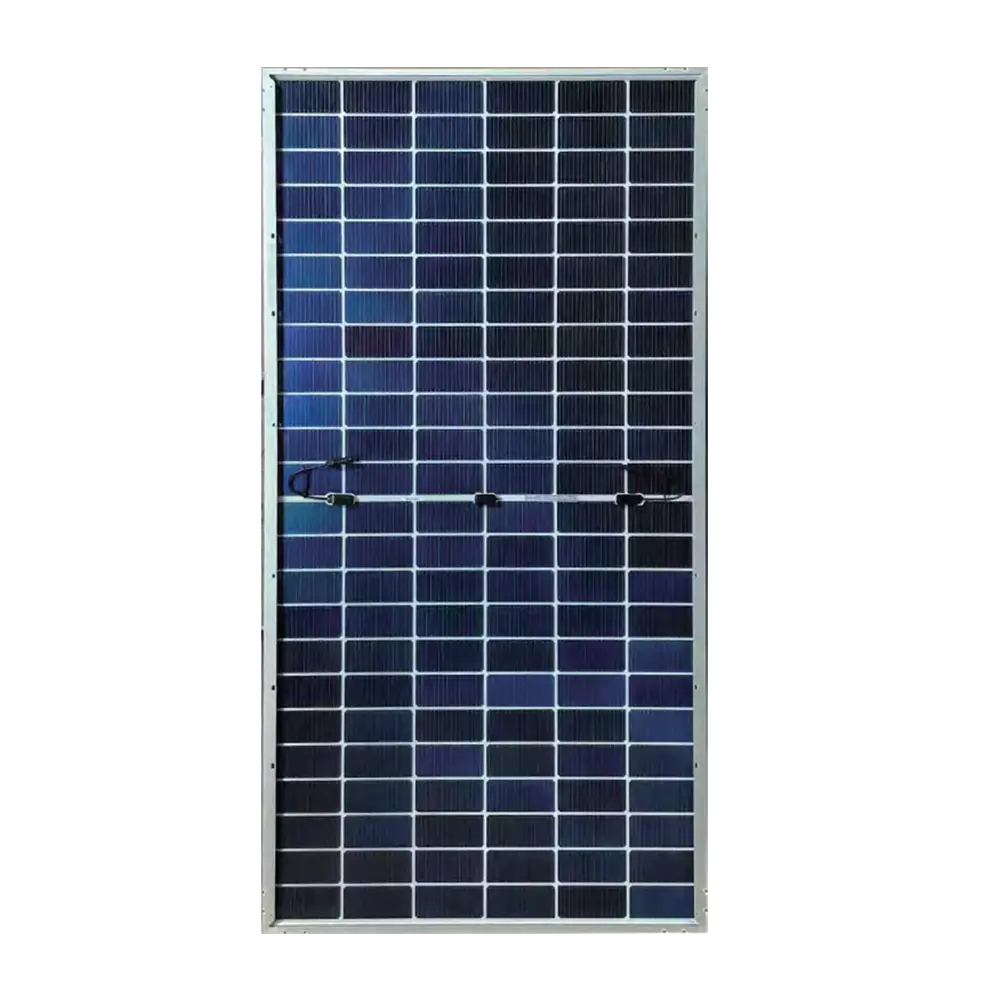
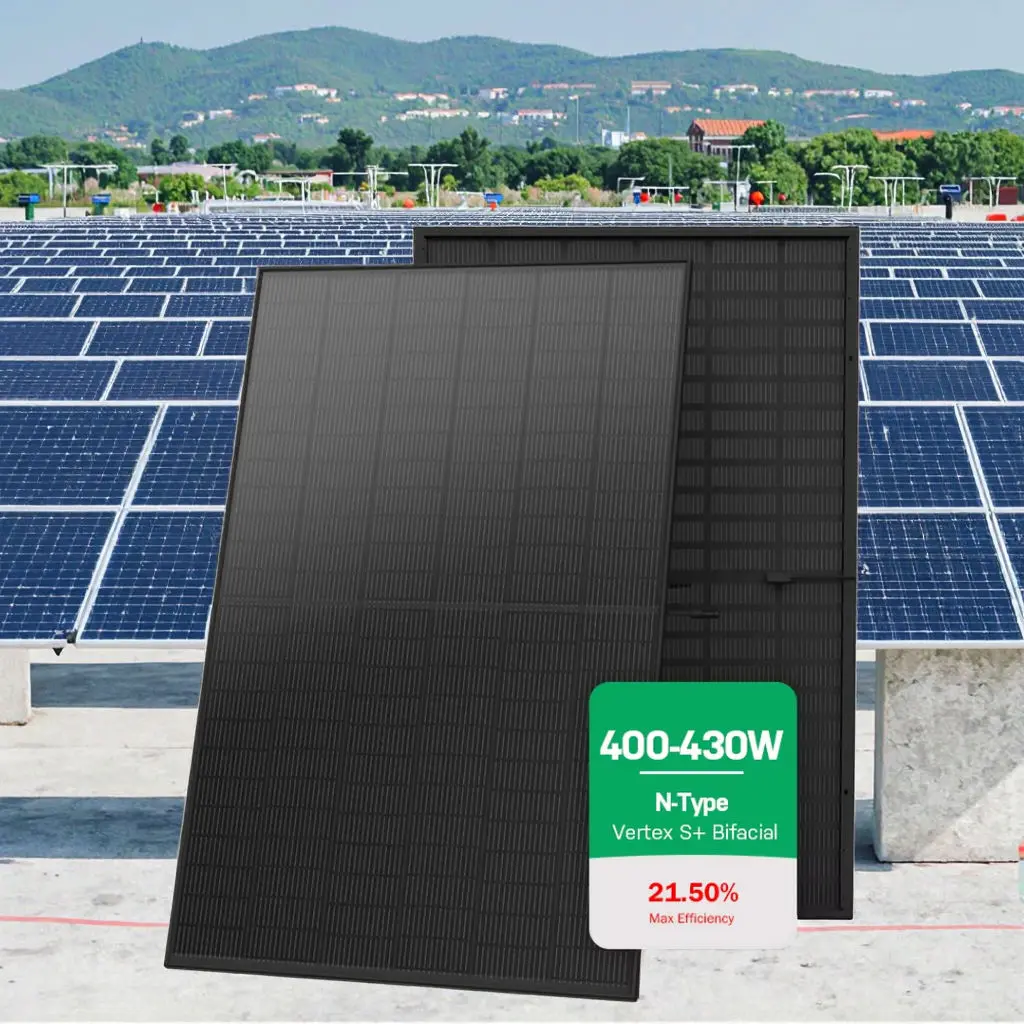
JUTA Power offers a comprehensive range of N-type monocrystalline solar panels designed to deliver the full benefits of TOPCon technology in a robust, field‑proven package. Available in 550W, 565W, 585W, and 600W configurations, these modules are optimized for commercial, industrial, and utility‑scale installations. For procurement specialists comparing 600W solar panel options, JUTA’s N‑type TOPCon modules represent the current state of the art.
Wichtige Spezifikationen
-
Cell type: 182mm × 182mm N‑type TOPCon
-
Cell arrangement: 144 cells (6 × 24)
-
Module efficiency: Up to 23.5%
-
Dimensions: 2279 × 1134 × 30mm with anodized aluminum frame
-
Junction box: IP68‑rated for superior weather resistance
-
Stecker: MC4‑compatible for universal installation
-
Temperature coefficient: -0.29%/°C (Pmax)
-
Bifaciality factor: Up to 85%
-
First‑year degradation: ≤ 1% (guaranteed)
-
25‑year output: ≥ 88% (guaranteed)
-
Certifications: CE certified, ISO9001 manufacturing
The 182mm wafer format represents the industry’s transition to larger, more cost‑effective cells. JUTA’s N-type monocrystalline solar panels leverage this format to reduce balance‑of‑system costs while maximizing energy density per square meter—a critical factor for commercial rooftop installations where space is at a premium.
Built for Harsh Environments
JUTA Power’s N-type monocrystalline solar panels are rigorously tested to withstand extreme conditions: high wind loads (up to 2400 Pa), snow loads (5400 Pa), and temperature cycling from -40°C to +85°C. The N‑type TOPCon architecture inherently resists potential‑induced degradation and hot‑spot overheating, ensuring reliable operation in desert, coastal, and high‑altitude sites. For project developers, these reliability features translate into lower maintenance costs and fewer warranty claims over the system’s lifetime.
Customization and Sourcing Support
JUTA Power provides full technical support for system design, including detailed electrical characteristics, temperature‑corrected IV curves, and bifacial gain modeling. Whether you need black‑frame modules for aesthetic integration or split‑junction boxes for reduced resistive losses, JUTA’s N-type monocrystalline solar panels can be tailored to meet specific project requirements. This flexibility, combined with a 12‑year product warranty and 25‑year linear performance warranty, makes JUTA a trusted partner for large‑scale solar developments. For buyers interested in solar panel sourcing from China, JUTA’s vertically integrated manufacturing ensures consistent quality and supply security.
Cost‑Benefit Analysis: Is the Premium for N-Type Monocrystalline Solar Panels Worth It?
With the cost premium for N-type monocrystalline solar panels now at 5‑10% over equivalent P‑type modules, the payback period is shorter than ever. Let’s examine a typical 10 kW commercial rooftop system.
Assumptions:
-
Annual irradiance: 1,500 kWh/m²/year
-
P‑type system: 10,000 kWh/year (estimated)
-
N‑type system: 10,750 kWh/year (7.5% higher, factoring degradation and temperature)
-
Electricity price: $0.12/kWh
-
System lifetime: 25 years
-
N‑type premium: 8% over P‑type
Additional annual revenue: 750 kWh × $0.12 = $90/year
25‑year cumulative extra revenue: $90 × 25 = $2,250 (undiscounted). Even with a 5% discount rate, the net present value of the additional energy exceeds $1,300—far more than the premium.
For utility‑scale projects, the economics are even more compelling. A 1% improvement in energy yield can add over $1 million in revenue over a 100 MW project’s life. Since N-type monocrystalline solar panels typically offer a 5‑8% yield advantage, the cumulative benefit runs into tens of millions of dollars.
Case study: A 10 MW system in Nevada with P‑type PERC showed first‑year generation deviation of 5.6% from the model, while a neighboring system with N-type monocrystalline solar panels deviated only 0.9%. Over five years, the N‑type system outperformed the P‑type by approximately 8%, leading to an extra $240,000 in revenue (at $0.10/kWh). The project owner credited the N‑type choice with accelerating the payback period by 1.2 years.
Practical Considerations When Specifying N‑Type Monocrystalline Solar Panels
While the technology is superior, successful deployment requires attention to a few nuances. For procurement managers evaluating N-type monocrystalline solar panels from multiple suppliers, here are the key criteria to assess.
Inverter Compatibility and Voltage Matching
N-type monocrystalline solar panels often have slightly higher open‑circuit voltage and lower temperature‑adjusted voltage drops. Ensure that your inverter’s maximum input voltage and MPPT range accommodate the specific Vmp and Imp of the selected module. JUTA provides detailed electrical data sheets to facilitate accurate sizing. This is particularly important for large commercial solar installations, where inverter string sizing affects overall system cost.
Mounting and Bifacial Optimization
To maximize bifacial gain, avoid shading the rear side of N-type monocrystalline solar panels. For ground‑mount systems, maintain a minimum clearance of 1 meter above the ground and choose reflective surfaces with albedo ≥ 0.3. For rooftop systems, consider elevated mounting structures that allow light to reach the rear side. JUTA’s engineering team can provide albedo‑specific yield models for your site.
Quality Assurance and Sourcing
Not all N-type monocrystalline solar panels are created equal. Insist on suppliers who perform rigorous factory testing, including electroluminescence imaging, flash testing at multiple irradiance levels, and thermal cycling. JUTA’s products undergo 100% EL inspection and are certified to IEC 61215 and IEC 61730 standards. Request test reports and, if possible, conduct on‑site pre‑shipment inspections. For commercial project procurement, third‑party testing verification is a standard best practice.
Conclusion: The Efficiency Question Is Settled
Are N-type monocrystalline solar panels more efficient than P‑type? The data is unequivocal: yes, by 1‑3 percentage points at the module level, and by 5‑10% in lifetime energy yield. The combination of higher initial efficiency, near‑zero LID, superior temperature coefficient, higher bifaciality, and lower annual degradation makes N-type monocrystalline solar panels the undisputed performance leader.
The cost premium has shrunk to a level where the economic case is irrefutable for most commercial and utility projects. With market share surpassing 90% and efficiency records continuing to fall, N-type monocrystalline solar panels are not a niche technology—they are the new industry baseline. For procurement professionals, EPC project managers, and asset owners, the choice is clear: N‑type is the future, and that future is already here.
Ready to specify N‑Type Monocrystalline Solar Panels for your next project? JUTA Power offers 550W, 565W, 585W, and 600W TOPCon modules with proven performance, bankable warranties, and flexible sourcing options. Contact our technical sales team today to discuss your project requirements and request a customized quote.