

Introducción
Selecting the right PWM solar charge controller or Regulador de carga solar MPPT is a critical step in designing an efficient and reliable solar power system. The choice directly influences energy harvesting efficiency, battery charging performance, system stability, and long-term return on investment. Whether for a small off-grid solar installation, residential energy solution, or commercial hybrid power project, understanding the differences between these two controller technologies helps engineers and buyers make more informed decisions.
This guide provides a comprehensive comparison of PWM and MPPT solar charge controllers, covering their operating principles, efficiency performance, application suitability, safety considerations, and procurement factors. By analyzing technical capabilities and real-world deployment scenarios, this article aims to help system integrators, procurement teams, and solar project developers select the most suitable charge controller based on their specific power requirements and project objectives.
1. How PWM and MPPT Solar Charge Controllers Work
1.1 PWM Charging Principle & Circuit Behavior
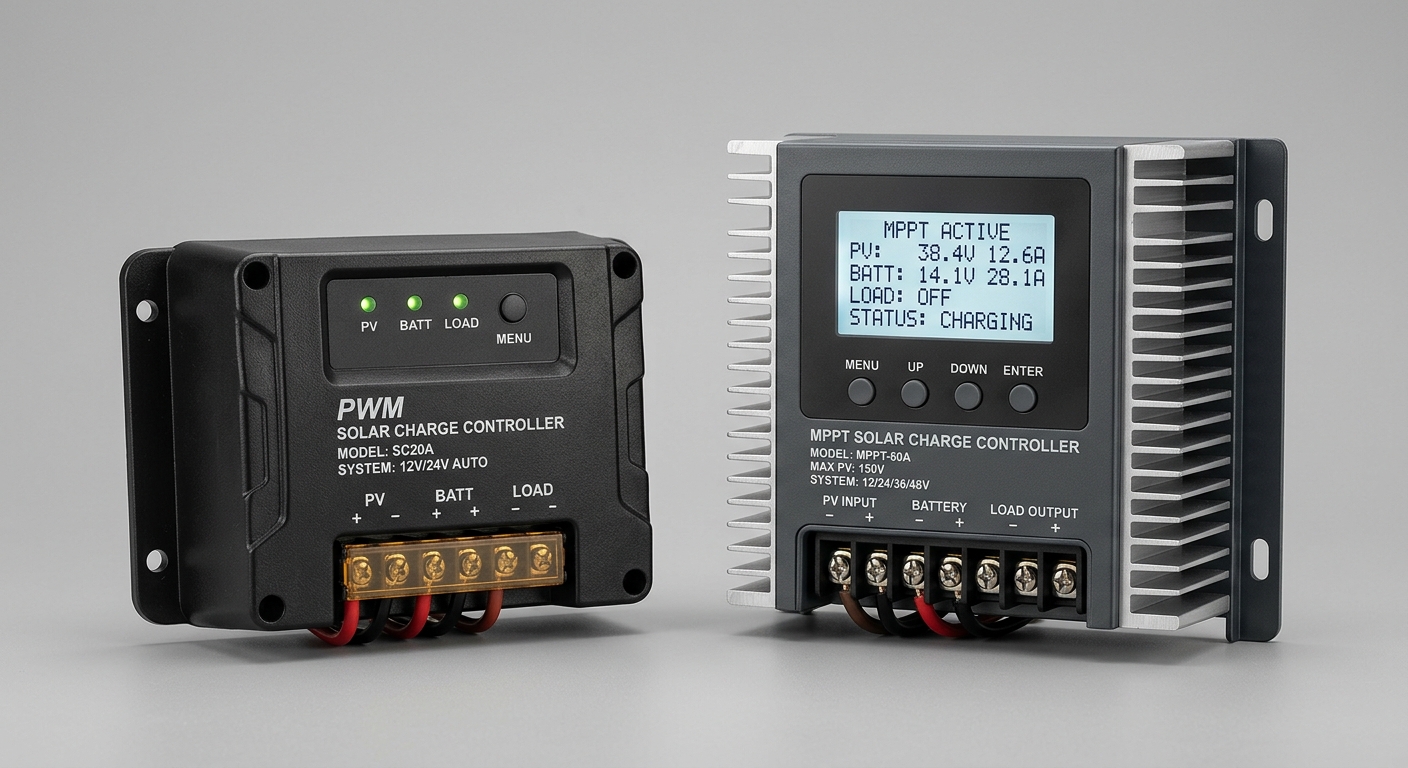
A PWM (Pulse Width Modulation) solar charge controller operates on a direct-connection topology—the solar panel is connected directly to the battery bank through a switching element. The controller regulates charging by rapidly switching the connection on and off, effectively reducing the average current delivered to the battery as it approaches full charge.
PWM controllers follow a standard three-stage charging cycle:
- Bulk Stage: Maximum current delivered until battery reaches target voltage
- Absorption Stage: Voltage held constant while current tapers
- Float Stage: Maintenance voltage applied to prevent self-discharge
The critical constraint of PWM topology is voltage matching: the panel’s operating voltage must closely match the battery bank voltage. A 12V battery system requires a panel with a Vmp (maximum power voltage) close to 14–15V. If panel voltage significantly exceeds battery voltage, the excess potential is dissipated as heat rather than harvested as usable energy. This architectural limitation defines the efficiency ceiling of PWM systems.
PWM controllers are mechanically simple, have minimal internal components, and are highly reliable in stable, matched-voltage configurations. Their low component count also makes them cost-effective to manufacture and maintain.
1.2 MPPT Tracking Algorithm & Power Conversion Logic
An MPPT (Maximum Power Point Tracking) solar charge controller introduces a DC-DC power conversion stage between the panel and battery. This buck (or boost) converter actively decouples the panel’s operating voltage from the battery voltage, allowing the controller to operate the panel at its true maximum power point regardless of battery state of charge.
The MPPT algorithm—typically Perturb & Observe (P&O) or Incremental Conductance—continuously samples panel voltage and current, calculates instantaneous power output, and adjusts the operating point to maintain peak power extraction. This happens in real time, responding to irradiance shifts, temperature changes, and partial shading events.
Because the converter can accept high-voltage panel strings (often 12V–150V input) and step down to match a 12V, 24V, or 48V battery bank, MPPT controllers unlock significant design flexibility. A 72-cell panel with a Vmp of 36V can efficiently charge a 12V battery—something a PWM controller cannot accomplish without substantial energy loss.
2. PWM vs MPPT Efficiency & Performance Comparison
2.1 Energy Harvest Efficiency Under Real-World Conditions
Under Standard Test Conditions (STC), the efficiency gap between PWM and MPPT is stark. A PWM controller’s effective energy harvest efficiency typically ranges from 75–80% when panel voltage exceeds battery voltage—the common real-world scenario. An MPPT controller operates at 93–99% conversion efficiency, capturing energy that PWM topology inherently discards.
The performance delta widens further under non-ideal conditions:
- Partial shading: MPPT algorithms can navigate multiple power curve peaks; PWM operates at a fixed voltage point and cannot adapt
- Low-irradiance (morning/evening): MPPT extracts usable power at lower irradiance thresholds; PWM may fail to initiate charging
- Climas fríos: Cold panels produce higher Voc and Vmp; MPPT harvests this voltage premium, while PWM wastes it
For a 400W system operating 250 days/year, the annual energy yield difference between PWM and MPPT can exceed 15–25%, translating directly into measurable kWh and battery cycle savings over a 5–10 year deployment.
2.2 Key Technical Specifications Comparison
| Parámetro | Controlador PWM | Controlador MPPT |
|---|---|---|
| Eficiencia típica | 75–80% | 93–99% |
| Input Voltage Range | Panel Vmp ≈ Battery Voltage | 12V–150V (model dependent) |
| Suitable Panel Power | ≤400W per unit | 400W–6000W+ per unit |
| Coste relativo | Low (1×) | Medium–High (2×–4×) |
| Compatibilidad de la batería | Lead-acid, Gel, AGM | Lead-acid, Gel, AGM, LiFePO₄ |
| Ideal System Scale | Small off-grid (12V/24V) | Mid-to-large off-grid/hybrid |
| Self-Consumption | 10–20mA | 20–50mA |
| Temperature Derating | Minimal | Moderate (built-in compensation) |
MPPT controllers also offer broader battery chemistry support, with programmable charge profiles for LiFePO₄ lithium banks—a critical advantage for modern storage-integrated systems.
3. Application Scenarios & System Selection Criteria
3.1 When PWM Is the Right Choice
PWM solar charge controllers remain the optimal selection for a well-defined set of applications. Key deployment scenarios where PWM delivers the best value include:
- Small off-grid systems at or below 400W where panel Vmp is appropriately matched to battery voltage
- 12V or 24V direct systems using standard 36-cell or 72-cell panels configured for voltage compatibility
- Budget-sensitive deployments such as rural electrification, agricultural monitoring, or low-cost backup lighting where minimizing capital expenditure is the primary constraint
- Replacement and maintenance scenarios where existing wiring, panel configurations, and enclosures are already sized for PWM operation
- High-temperature, simple environments where MPPT’s added electronics introduce unnecessary failure points
In these contexts, the PWM controller’s simplicity, lower heat generation, and lower purchase price produce a better total cost of ownership than an MPPT unit whose efficiency gains cannot offset its price premium at small scale.
3.2 When MPPT Delivers Superior ROI
MPPT becomes the technically and commercially superior choice when system scale, panel configuration, or performance requirements exceed PWM’s architectural limits:
- High-voltage panel strings: Modern 60-cell and 72-cell panels with Vmp of 30–40V are fundamentally mismatched with 12V batteries under PWM topology. MPPT resolves this without re-wiring
- Large off-grid and hybrid systems (≥600W): The efficiency premium of MPPT generates measurable kWh gains that amortize the higher controller cost within 12–24 months in most climates
- Cold-climate installations: Elevated panel Voc in winter conditions can damage PWM controllers or trigger protection shutdowns; MPPT handles wide input voltage ranges safely
- Commercial and industrial projects: Where LCOE (Levelized Cost of Energy) calculations govern procurement, MPPT’s 15–25% yield advantage compounds over the project lifetime
- LiFePO₄ battery systems: Lithium batteries require precise, programmable charge profiles that most MPPT controllers support natively
For any system in which the panel array voltage exceeds the battery bank voltage by more than 20%, MPPT is not merely preferable—it is the technically correct solution.
4. Compliance Standards, Safety Ratings & Procurement Considerations
4.1 Certifications & Regulatory Requirements
For B2B procurement, compliance documentation is non-negotiable. Qualified PWM and MPPT solar charge controllers should carry the following certifications and protection ratings:
- Marcado CE: Confirms conformity with EU Low Voltage Directive and EMC Directive—mandatory for European market access
- RoHS Compliance: Restricts hazardous substances in electronic components; required for EU and increasingly for global tenders
- IEC 62509: The primary international standard governing battery charge controller performance for stand-alone photovoltaic systems
- UL Listing: Required for North American residential and commercial installations; increasingly specified in utility-scale procurement
- IP Rating: IP32 minimum for indoor/sheltered installations; IP43 or higher for outdoor or dusty environments
Essential built-in protections to verify in product specifications:
- Over-voltage protection (OVP)
- Reverse polarity protection
- Short-circuit and overload protection
- Over-temperature protection with automatic derating
- PV reverse current protection (night discharge prevention)
Absence of any of these protections should be treated as a disqualifying factor in supplier evaluation.
4.2 Total Cost of Ownership & Supplier Evaluation Checklist
The upfront price difference between PWM and MPPT controllers (typically 2×–4× at equivalent current ratings) must be evaluated against 5-year energy yield projections. For systems above 400W in non-ideal irradiance conditions, MPPT’s yield advantage frequently offsets its cost premium within the first two years of operation.
Supplier evaluation criteria for procurement teams:
- Warranty terms: Minimum 2 years; prefer suppliers offering 3–5 year coverage with documented RMA processes
- OEM/ODM availability: Critical for system integrators requiring custom branding, communication protocols (RS485/Modbus), or enclosure modifications
- After-sales technical support: Verify availability of English-language technical documentation, firmware update support, and regional service contacts
- Production certifications: ISO 9001 manufacturing quality certification indicates process consistency for volume orders
- Batch testing reports: Request sample QC reports including efficiency curves and protection trigger thresholds
Preguntas frecuentes
Q1: Can I use a PWM solar charge controller with a 24V panel on a 12V battery system?
Technically, a PWM controller will connect them—but you will lose approximately 50% of potential energy. A 24V panel (Vmp ~30V) connected via PWM to a 12V battery operates the panel at ~14V, well below its maximum power point. The result is severe energy waste. For this configuration, an MPPT controller is the correct and only efficient solution.
Q2: What is the minimum system size where upgrading to MPPT becomes cost-justified?
As a general benchmark, MPPT becomes cost-justified at approximately 400–600W of panel capacity, provided the panel voltage exceeds the battery voltage by more than 15–20%. Below 400W with matched panel/battery voltages, PWM’s lower cost typically wins on TCO. Above 600W, MPPT’s yield gains consistently outpace the price premium within 18–24 months.
Q3: Are MPPT controllers compatible with both lithium and lead-acid battery banks without reconfiguration?
Most commercial MPPT controllers support multiple battery chemistries through user-selectable charge profiles. Switching from lead-acid to LiFePO₄ requires changing the charge voltage parameters (typically via DIP switches, LCD menu, or PC software). Verify that the specific model includes a dedicated lithium charge profile before procurement—not all budget MPPT units do.
Conclusión
The PWM vs. MPPT decision is not about which technology is universally superior—it is about matching controller architecture to system requirements. PWM solar charge controllers deliver reliable, cost-effective performance for small, voltage-matched, budget-constrained deployments. MPPT solar charge controllers are the correct specification for any system where panel voltage exceeds battery voltage, scale demands efficiency, or long-term LCOE is a procurement metric.
For procurement engineers and system integrators, the decision framework is straightforward: define your panel array voltage, battery bank voltage, total system wattage, and project lifetime. If the numbers point to MPPT, the efficiency gains will justify the investment. If your application is genuinely small and voltage-matched, PWM remains a technically sound and commercially rational choice.
The next step is supplier qualification—prioritize certified products with documented protection features, verifiable efficiency data, and responsive technical support to ensure your solar charge controller performs to specification across its full service life.